How Pickleball Scoring Works: Beginner Guide
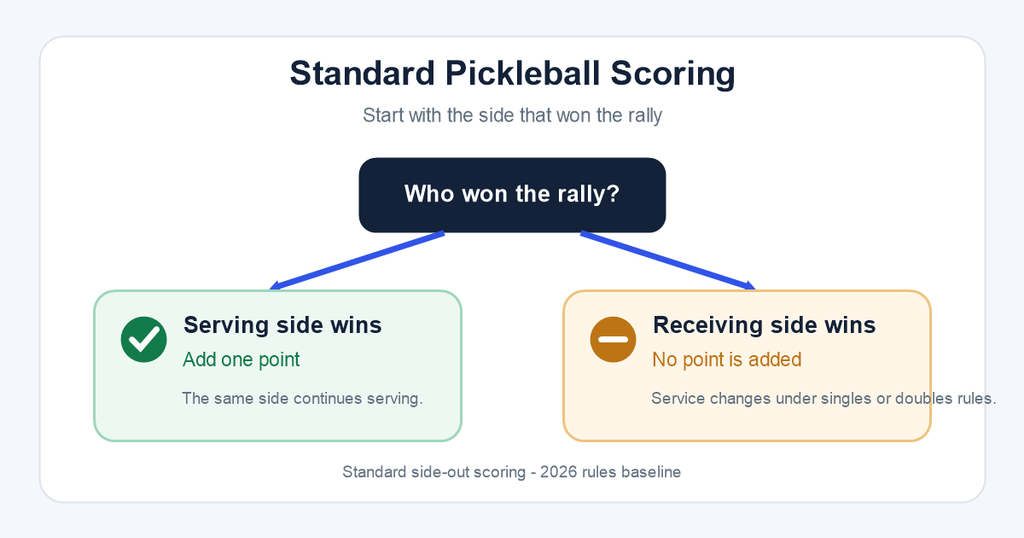
Under standard pickleball scoring, only the serving side can earn a point. If the serving side wins the rally, it scores. If the receiving side wins, the score stays the same and the serving situation changes.
That basic rule applies to both singles and doubles, but service changes differently:
- In singles, the serve passes to the opponent.
- In standard doubles, the serve normally passes from Server 1 to Server 2 before moving to the other team.
This guide uses the 2026 USA Pickleball Official Rulebook as its rules baseline. PlaySmashZone is an independent website and is not affiliated with or endorsed by USA Pickleball.
Pickleball Scoring in 60 Seconds
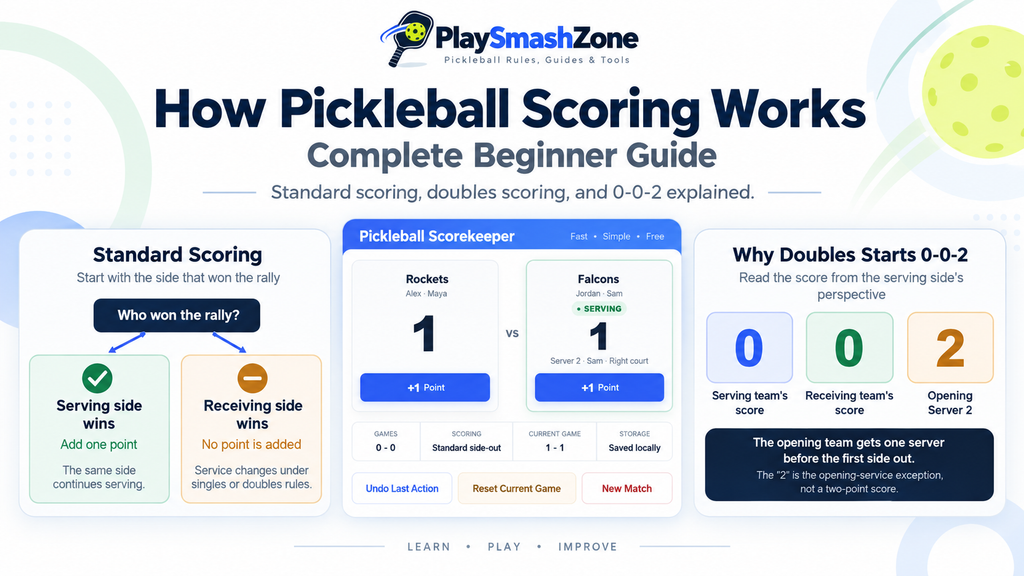
- Under standard scoring, only the serving side can score.
- A rally is the period of play from the serve until the ball becomes dead.
- Singles score calls have two numbers: server’s score, then receiver’s score.
- Standard doubles score calls have three numbers: serving team’s score, receiving team’s score, then the server number.
- Most standard doubles service rotations include Server 1 and Server 2.
- A standard doubles game begins at 0-0-2 because the opening team receives only one server before the first side out.
- When the server’s score is even, a singles player serves from the right. When it is odd, the player serves from the left.
- Games use an agreed target, commonly 11, 15 or 21 in the formats discussed below, and the relevant formats are won by two points.
- The 2026 rulebook also contains a provisional rally-scoring option in which every rally produces a point.
What Is a Rally?
A rally is the continuous play that begins when the serve is hit and ends when the ball becomes dead.
For example, a rally ends when someone commits a fault, the ball lands out or the ball legally bounces twice.
The rally winner matters because it determines whether a point is scored and who serves next.
How Standard Pickleball Scoring Works
Rule 4.A establishes the central rule of standard scoring: the serving side scores a point when it serves and wins the rally.
Suppose Player A serves with the score at 3-2:
- If Player A wins the rally, the score becomes 4-2.
- If Player B wins while receiving, the score remains 3-2. Player B does not receive a point, but service changes.
In doubles, the same point-scoring rule applies. However, a receiving-team rally win may move service to the serving team’s second server rather than immediately producing a side out.
What Is a Side Out?
A side out means that service is awarded to the opposing side.
In singles, a side out occurs when the server loses a rally. The receiver does not score under standard scoring but becomes the new server.
In standard doubles, both partners normally receive an opportunity to serve during a service rotation:
- Server 1 serves until the serving team loses a rally.
- The serve then passes to Server 2.
- If Server 2 loses a rally, a side out occurs and the other team serves.
The beginning of each game is the exception. The first serving team starts with its opening server designated as Server 2, so that team has only one server before the first side out.
The PlaySmashZone Pickleball Scorekeeper tracks these transitions automatically. During play, you tap the player or team that won the rally; the tool applies the point and service consequence for the selected format.
How Singles Scoring Works
Standard singles uses a two-number score call:
Server’s score – Receiver’s score
If the server leads 6-4, the score is called 6-4.
When the server wins a rally:
- The server receives one point.
- The server continues serving.
- The server changes serving sides because the score has changed from even to odd or odd to even.
When the receiver wins:
- No point is awarded.
- A side out occurs.
- The receiver becomes the new server.
Because the serving side is always named first, the order of the two numbers can change when service changes.
Right or Left Serving Position in Singles
The server’s score determines the correct serving side:
- Zero or an even score: serve from the right.
- An odd score: serve from the left.
Examples:
- At 4-3, the server has four points and serves from the right.
- At 5-3, the server has five points and serves from the left.
The receiver takes the diagonally opposite receiving position.
How Doubles Scoring Works
A doubles team has two players, and standard doubles normally gives both players a serving opportunity before a side out.
After a team gains service, the player correctly positioned on the right according to the team’s score becomes Server 1. That player continues serving while the team wins rallies, alternating between the right and left serving sides after each point.
If the serving team loses a rally while Server 1 is serving:
- The score does not change.
- The serve passes to the partner.
- That partner becomes Server 2 for the remainder of the service rotation.
If the team loses a rally while Server 2 is serving:
- The score still does not change.
- A side out occurs.
- The opposing team gains service and begins with Server 1.
Server 1 and Server 2 are not permanent player identities. They describe the players’ roles during the current service rotation. A player may be Server 1 during one rotation and Server 2 during another.
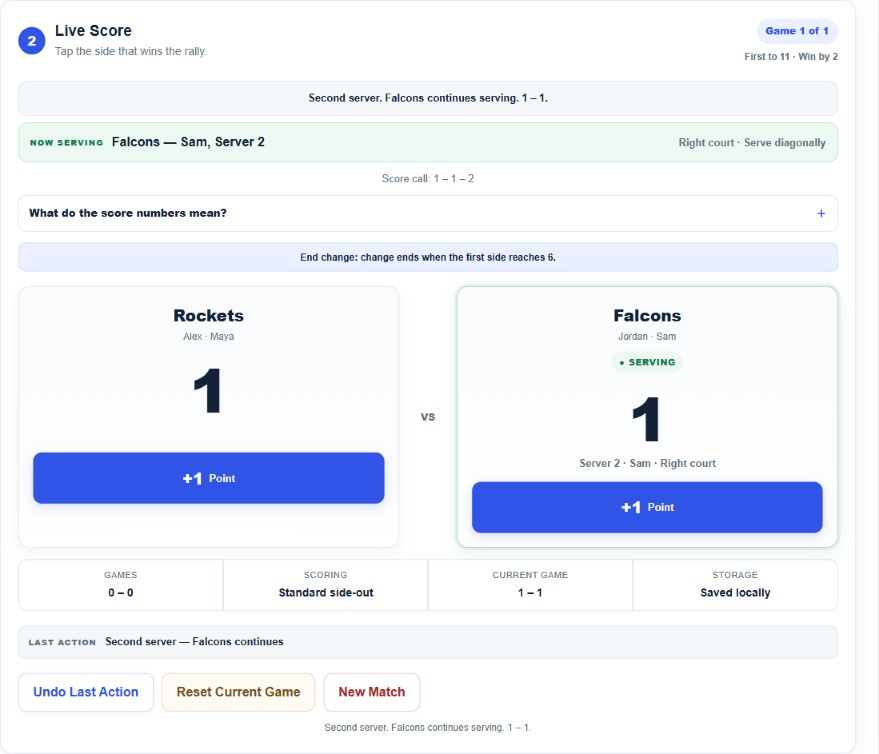
The Scorekeeper screen above shows a standard doubles game at 1-1-2. Falcons are serving, Sam is Server 2, and the interface identifies the correct serving position as the right court.
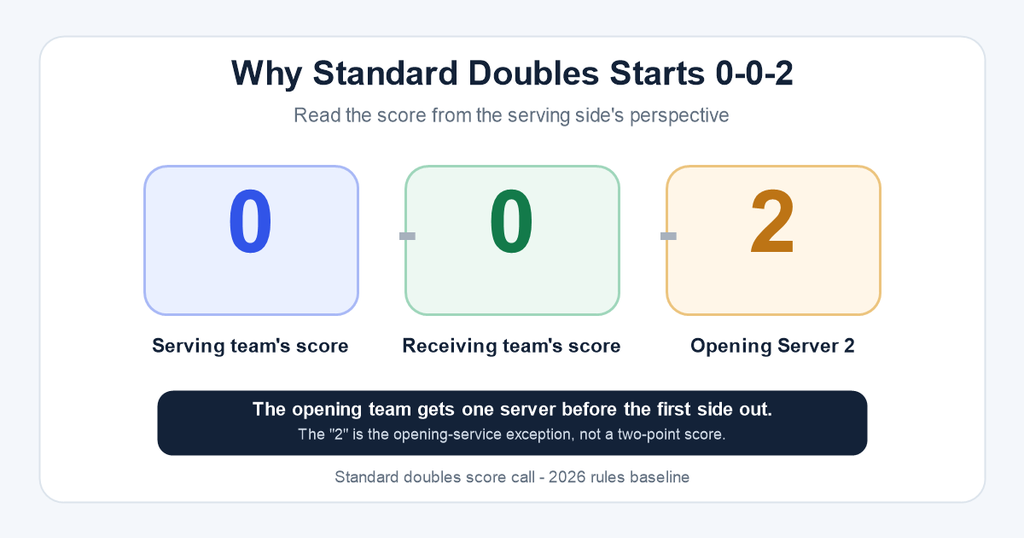
Why Does Pickleball Start at 0-0-2?
A standard doubles game begins with the score call 0-0-2:
- The first 0 is the serving team’s score.
- The second 0 is the receiving team’s score.
- The 2 means the opening server is treated as Server 2.
This is the opening-service exception in Rule 5.B. Instead of letting both members of the first team serve before a side out, the first team receives one server.
If that opening server loses a rally, the other team gains service and starts its first service rotation with Server 1.
The third number does not mean that anyone has scored two points.
How to Call the Score
The score is called from the serving side’s perspective. This means the serving player’s or serving team’s score comes first.
Singles Score Call
Server’s score – Receiver’s score
Example: 6-4
The server has six points and the receiver has four.
Standard Doubles Score Call
Serving team’s score – Receiving team’s score – Server number
Example: 7-5-1
This means:
- The serving team has seven points.
- The receiving team has five points.
- Server 1 is serving.
If service later moves to the opposing team, that team’s score is called first.
Provisional Rally-Scoring Score Call
Under the 2026 provisional rally-scoring option, the score is called with two numbers:
Server’s score – Receiver’s score
That two-number format also applies to rally-scoring doubles. There is no Server 1 or Server 2 number because rally-scoring doubles uses one server per service rotation.
Standard Doubles Scoring Example: Rally by Rally
Consider a standard doubles game between Team A and Team B. Team A serves first.
Start: 0-0-2
Team A’s opening server is treated as Server 2. Both teams have zero points.
Rally 1: Team A wins
Because Team A is serving, it scores a point.
New score call: 1-0-2
The opening server continues serving.
Rally 2: Team B wins
Team B is receiving, so it does not score. Team A’s opening server was already Server 2, so the loss produces a side out.
Team B now serves. Its score must be called first.
New score call: 0-1-1
Team B has zero points, Team A has one, and Team B begins with Server 1.
Rally 3: Team B wins
Team B is serving, so it earns a point.
New score call: 1-1-1
Team B’s Server 1 continues serving.
Rally 4: Team A wins
Team A is receiving, so no point is awarded. Team B’s Server 1 loses the serve, and Team B’s partner becomes Server 2.
New score call: 1-1-2
Rally 5: Team A wins again
Team A is still receiving, so the score remains tied. Team B’s Server 2 loses the rally, producing a side out.
Team A regains service and begins with Server 1.
New score call: 1-1-1
The numbers appear similar to an earlier call, but the serving team and active server have changed. This is why following only the scoreboard can be confusing: you also need to know who is serving and whether that player is Server 1 or Server 2.
How Many Points Do You Need to Win?
The required target depends on the selected match format.
The 2026 rulebook’s standard tournament-scoring options include:
- Best two of three games to 11.
- Best three of five games to 11.
- One game to 15 or 21.
- One game to 11 for the specified larger round-robin format.
The provisional rally-scoring tournament options include one-game, best-two-of-three and best-three-of-five formats using targets of 11, 15 or 21, subject to the rulebook’s tournament restrictions.
Casual players should agree on the target and scoring format before play begins rather than assuming every match uses the same arrangement.
The PlaySmashZone Scorekeeper supports:
- A standard-scoring single game to 11, 15 or 21.
- Standard best-two-of-three or best-three-of-five matches with games to 11.
- Provisional rally-scoring matches using one game, best two of three or best three of five, with targets of 11, 15 or 21.
All formats offered by the Scorekeeper use a win-by-two finish.
What Does “Win by Two” Mean?
Reaching the target is not enough if the lead is only one point. The winning side must lead by at least two.
In a game with a target of 11:
- 11-9: the game is over.
- 11-10: the game continues.
- 12-10: the game is over.
The same principle applies to other supported targets when the format requires a two-point winning margin.
What Happens at 10-10?
A tied score of 10-10 in an 11-point, win-by-two game is sometimes called a deuce situation, although the rule itself is simply that a two-point lead is required.
The next point does not automatically win:
- At 11-10, play continues.
- If the score reaches 11-11, the game remains tied.
- A result such as 12-10 or 13-11 ends the game.
There is no fixed maximum score in an ordinary win-by-two game. Play continues until one side establishes the required margin.
How Multi-Game Matches Work
A match may use one game or a best-of format.
- One game: the side that wins that game wins the match.
- Best two of three: the first side to win two games wins the match.
- Best three of five: the first side to win three games wins the match.
A best-of-three match does not always require all three games. If one side wins the first two, the match is complete. The same principle applies to a best-of-five match, which can finish after three games.
The PlaySmashZone Scorekeeper records completed games, displays games won and advances the match until one side reaches the required number of game wins.
Standard Scoring vs 2026 Provisional Rally Scoring
| Feature | Standard scoring | 2026 provisional rally scoring |
|---|---|---|
| Who can score? | Only the serving side | The winner of every rally |
| Receiving side wins a rally | No point; the service sequence changes | Receiving side scores and gains service |
| Doubles servers per service rotation | Normally two, except the opening rotation | One |
| Doubles score call | Three numbers | Two numbers |
| Status in the 2026 rulebook | Baseline standard format | Provisional option; it did not replace standard scoring |
How Rally Scoring Works
Under the 2026 provisional rally-scoring option, the player or team that wins each rally receives a point, regardless of who served.
If the serving side wins:
- It earns a point.
- The server continues, alternating serving sides according to the score.
If the receiving side wins:
- It earns a point.
- It gains service.
In rally-scoring doubles, one player serves during each service rotation. When the serving team loses a rally, a side out occurs and service moves to the opposing team. There is no first-server-to-second-server transition.
The score call uses two numbers: the server’s score followed by the receiver’s score.
Rally scoring appears as a provisional option in the 2026 rulebook. It did not replace standard scoring, and tournament use is subject to the conditions and exclusions stated in that rulebook.
How End Changes Work
The 2026 rulebook’s tournament procedures require an end change during a single-game match or the tie-breaker game of a multi-game match at these thresholds:
| Game target | Change ends when the first side reaches |
|---|---|
| 11 points | 6 |
| 15 points | 8 |
| 21 points | 11 |
The same server continues after the end-change break.
These are tournament provisions rather than a claim that every informal game must be administered in exactly the same way. Casual players can agree on their court-change procedure before play.
The PlaySmashZone Scorekeeper displays the applicable end-change reminder for its supported single-game and deciding-game formats.
Common Pickleball Scoring Mistakes Beginners Make
Adding a point when the receiving side wins
Under standard scoring, the receiver does not receive a point. Update the service situation, but leave the score unchanged.
Treating Server 1 and Server 2 as permanent identities
The numbers describe the current service rotation. They do not permanently belong to particular players.
Forgetting the opening exception
Standard doubles begins at 0-0-2. The first team gets one server before the first side out.
Calling a fixed team’s score first
The serving side’s score is called first. The order can reverse when service changes.
Moving directly to a side out after Server 1 loses
In a normal standard doubles rotation, the partner becomes Server 2. A side out follows when Server 2 loses.
Serving from the wrong side in singles
Use the server’s score: even or zero means right; odd means left.
Mixing standard and rally-scoring rules
Decide on the format before the match. Standard scoring does not award a point to the receiving side, while rally scoring does.
Manually adding a point for every rally in a scorekeeping app
A rally winner and a point winner are not always the same thing under standard scoring. In the PlaySmashZone Scorekeeper, tap the side that won the rally and let the selected scoring format determine whether a point should be added.
How the PlaySmashZone Scorekeeper Helps
Pickleball becomes difficult to track when you try to remember the score, serving team, active player, server number and court position at the same time.
The PlaySmashZone Pickleball Scorekeeper keeps these parts of the match together:
- Current score.
- Serving side.
- Active server.
- Server 1 or Server 2 in standard doubles.
- Right or left serving position.
- Correct score call.
- Current game.
- Games won.
- Completed-game history.
- Overall match progress.
- Standard or provisional rally-scoring format.
The main instruction is simple: tap the player or team that won the rally.
That is different from manually pressing a button to add a point. Under standard scoring, a receiving-side rally win may change the server without changing the score. The Scorekeeper applies that consequence automatically.
What If a Rally Result Is Disputed?
The Scorekeeper records a result after the players determine who won the rally. It does not independently decide whether a serve, shot or action was legal.
Questions involving non-volley-zone faults, serve legality, line calls, hinders, replays or other rule situations should be resolved first.
For scenario-based guidance, use the PlaySmashZone Pickleball Rule & Fault Checker, then return to the Scorekeeper and record the rally’s agreed result.
Frequently Asked Questions
Can the receiving side score in pickleball?
Not under standard side-out scoring. If the receiving side wins, the score stays the same and the serving situation changes. Under the 2026 provisional rally-scoring option, the receiving side does earn a point.
Why does doubles start at 0-0-2?
The two zeroes are the teams’ scores. The final two designates the opening server as Server 2, giving the first serving team only one server before the first side out.
Does pickleball always go to 11?
No. The applicable rules and Scorekeeper configurations include games to 11, 15 and 21, depending on the selected match and scoring format.
What happens at 10-10?
In an 11-point, win-by-two game, play continues until one side leads by two. A score of 11-10 is not enough to win.
What do Server 1 and Server 2 mean?
They are temporary serving roles during a standard doubles service rotation. Server 1 serves first after a side out, followed by Server 2 if the team loses a rally.
How do I know whether to serve from the right or left?
In singles, use the server’s score: even or zero serves from the right; odd serves from the left. Doubles positions also depend on the team’s score and its designated starting server.
Is rally scoring part of the 2026 rules?
Yes, but it is identified as a provisional option. It did not replace standard scoring, and its use in tournaments is subject to stated restrictions.
How can I keep track of the score while playing?
Track more than the two point totals. You also need the serving side, active server, court position and—under standard doubles—the server number. The PlaySmashZone Scorekeeper tracks these together when you tap the rally winner.
Once you understand who can score, who serves next and how the score call works, pickleball scoring becomes much easier to follow.
Try the PlaySmashZone Pickleball Scorekeeper during your next match.