Pickleball Serving Rules: Legal Serves & Faults (2026)
A legal pickleball serve depends on where you stand, how you release and hit the ball, and where it lands. Getting the ball over the net is only one part of the job.
The 2026 rules allow a volley serve, hit before the ball bounces, and a drop serve, hit after a permitted drop and bounce. Their motion requirements differ, but both must follow the applicable serving-position, release, timing and placement rules.
The explanations below use the 2026 USA Pickleball Official Rulebook. PlaySmashZone is an independent website, not an official USA Pickleball service or officiating authority.
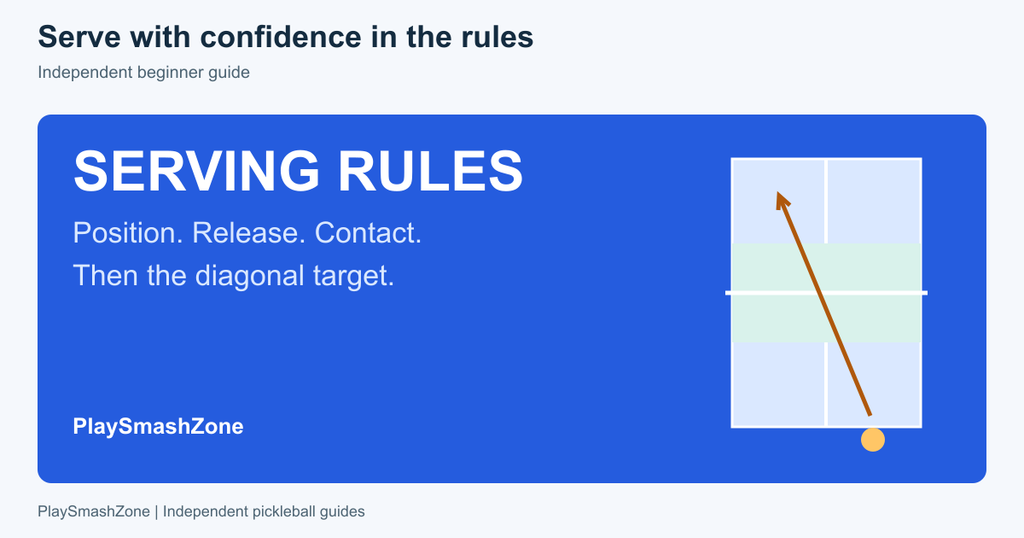
Where Must You Stand to Serve?
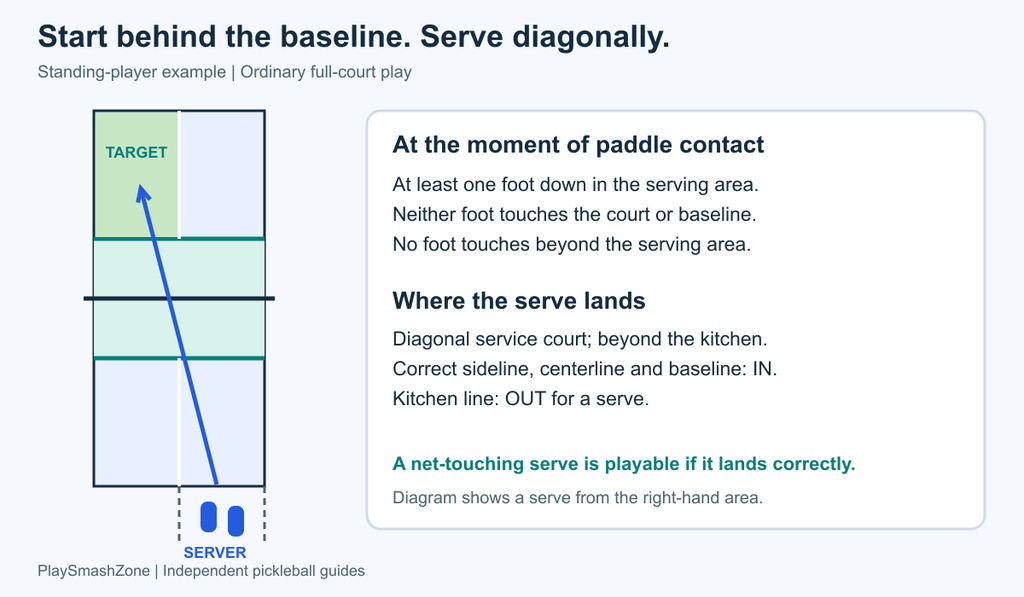
For a standing player, check the position of your feet at the moment the paddle hits the ball:
- At least one foot must touch the correct serving area behind the baseline.
- Neither foot may touch the court, including the baseline.
- Neither foot may touch the playing surface outside the correct serving area.
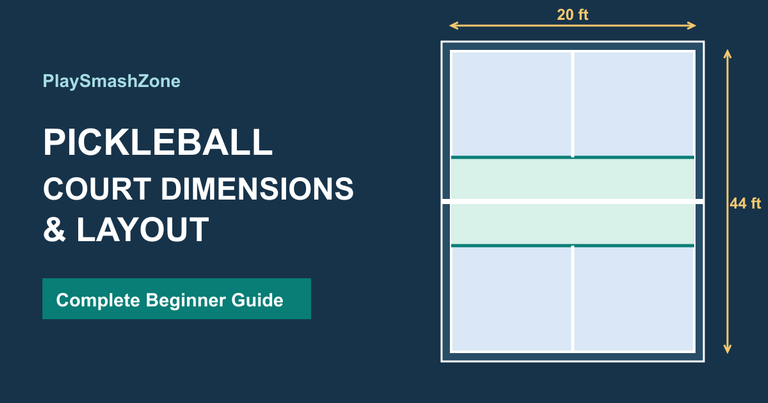
The serving area is the space behind the relevant half of the baseline. Its side boundaries are imaginary extensions of the centerline and sideline. Those imaginary boundary lines are included in the area; ground contact beyond them is not allowed.
You may lift one foot if the other is correctly grounded and the lifted foot is not making prohibited ground contact. Hitting the serve with both feet airborne is a fault.
For example, having one foot safely behind the baseline does not make a serve legal if the other toe touches the baseline at contact.
Where Must the Serve Land?
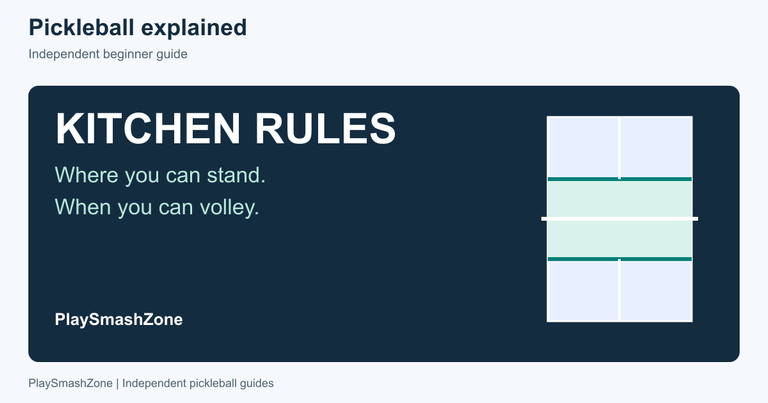
In ordinary full-court pickleball, serve into the service court diagonally opposite your correct position. The ball must clear the opponent’s non-volley zone, or kitchen, and land in that diagonal service court.
The landing lines do not all receive the same treatment:
- Correct service court’s sideline, centerline or baseline: in.
- Kitchen line: out for a serve.
- Inside the kitchen, in the wrong service court or beyond the legal boundaries: a service fault.
These distinctions come from the service-court definition and Rules 7.E and 8.B–8.C. A serve that lands on the centerline beyond the kitchen is therefore in; one that lands where the centerline meets the NVZ line is not beyond the kitchen.
What If the Serve Touches the Net?
A serve may touch the net and remain playable if it clears the kitchen and lands in the correct service court. A net touch alone does not require a replay.
If that same net-touching serve drops into the kitchen, it is a fault because of where it lands.
Volley Serve and Drop Serve: Choose the Correct Rule Set
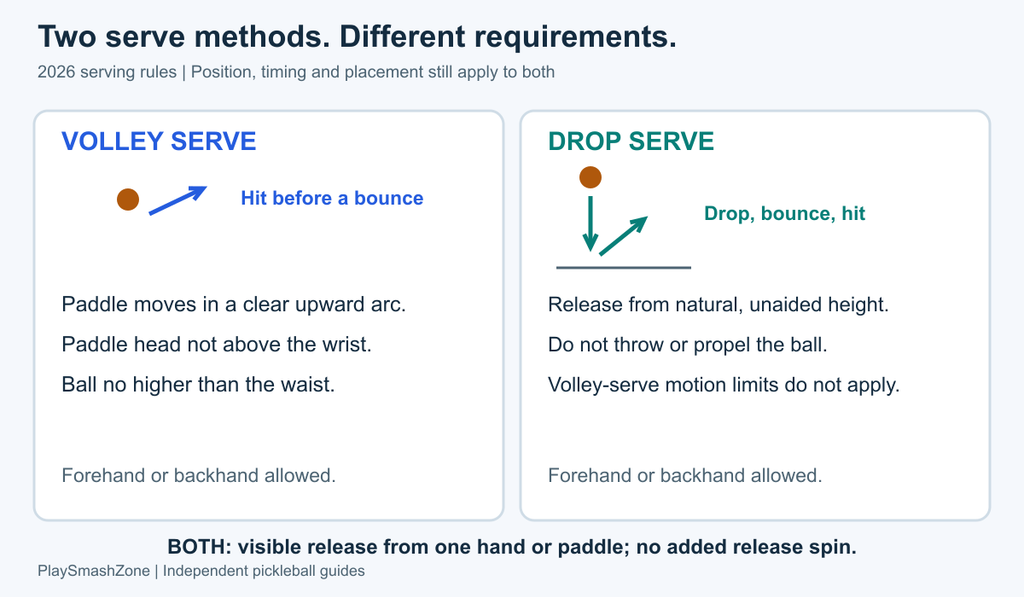
| Requirement | Volley serve | Drop serve |
|---|---|---|
| When the ball is struck | Before it bounces | After it bounces following a permitted drop |
| Release | From one hand or only the paddle; visible to the receiver | Same, from a natural, unaided height without propelling the ball |
| Motion at contact | Clear upward paddle arc; paddle-head and ball-height limits | The volley-serve motion limits do not apply |
| Forehand or backhand | Either | Either |
| Position and target | Legal serving area and diagonal service court | Same |
Volley Serve Rules
For a volley serve, Rule 7.C sets three conditions at paddle contact:
- The paddle must be moving in a clear upward arc.
- The highest point of the paddle head must clearly be no higher than the highest part of the wrist joint.
- The ball must clearly be no higher than the server’s waist.
All three matter. Hitting below the waist does not excuse a paddle head that is too high, and an upward swing does not excuse contact above the waist.
Either a forehand or backhand motion may be used. A backhand is not automatically illegal, but it must satisfy the same conditions.
An upward toss is not prohibited for a volley serve. The separate rules about a visible, permitted release and no deliberately added release spin still apply, and the contact must satisfy the volley-serve limits.
Drop Serve Rules
A drop serve begins with the ball released from a natural, unaided height. Let gravity cause the drop, allow the ball to bounce on the playing surface, then hit it.
You must not throw it upward, push it downward or propel it sideways to create the bounce. Calling a forceful downward throw a “drop” does not make it legal.
Before you strike the drop serve:
- The rules do not restrict the number of preparatory bounces.
- They do not restrict where those bounces occur on the playing surface.
- The serving-position and timing requirements still apply.
For example, the ball may bounce inside the baseline before you hit a drop serve, provided your feet remain legally positioned when you strike it. The ball’s pre-serve bounce location and your feet’s contact position are different questions.
The volley serve’s upward-arc, paddle-head and waist restrictions do not govern a drop serve. This does not remove the drop serve’s own release requirements.
Can You Spin the Ball Before Serving?
You must not deliberately manipulate the ball to add spin before striking the serve, whether using your body or the paddle. Some natural rotation during release is expected and is not the same as intentionally loading spin onto the ball.
Rule 7.B.2 expressly allows the ball to roll off the paddle face through gravity. It also permits spin produced when the paddle strikes the ball.
The useful distinction is between adding prohibited spin during preparation or release and producing spin through the legal hitting action.
Why the Outcome May Be Replay or Fault
In play without a referee, Rule 7.B.2.a allows the receiver to request a replay if they determine that manipulation or spin was added during release. They must make that call before returning the serve.
In an officiated match, a referee who identifies prohibited manipulation or spin calls a fault under Rule 20.E.1.e. Questionable manipulation or spin may instead lead to a referee-called replay under Rule 20.E.2.c.
“Every spin concern is automatically a fault” therefore misses a material procedural distinction.
Does the Receiver Have to See the Ball Release?
Yes. The release must be visible to the receiver for either serve method.
Under the general rule, a receiver who cannot see the release may call for a replay, but must do so before returning the serve. Returning it and then requesting this particular replay is too late.
In an officiated match, Rule 20.E.2.a governs the referee’s visibility decision. A questionable case may produce a replay; when the referee is certain the release was not visible, a replay is required. Referee-called service replays must precede the return.
Which Side Do You Serve From?
In standard singles, use the server’s score:
- Zero or even: right serving area.
- Odd: left serving area.
Standard doubles requires tracking the players as well as the team score. A team’s designated starting server belongs on the right at an even team score and on the left at an odd score; the partner’s positions are the opposite.
After a side out—the transfer of service to the other team—the correctly positioned right-side player serves first. During a serving turn, the server changes sides after the team scores.
Do not apply the singles shortcut as “every doubles server serves right when the team score is even.” The player’s identity matters too.
If unsure, ask who should serve and from where before serving. Player-position errors have their own correction and replay provisions in Rule 5.C; they should not all be labelled ordinary service foot faults.
How Long Do You Have to Serve?
The entire score must be called before you hit the serve. You then have 10 seconds after the completed score call to serve under Rule 6.D.
The clock is not defined as “10 seconds after picking up the ball” or “after deciding you are ready.”
If the serving team changes serving areas after the score call, the other players must be allowed to reposition and the score must be called again, restarting the count. In an officiated match, the referee manages that process.
What Counts as a Service Fault?
Common faults include:
- Both feet being airborne, a foot touching the court or baseline, or prohibited ground contact outside the serving area at contact.
- Violating a volley serve’s upward-motion, paddle-head or ball-height requirement.
- Propelling a drop-serve ball or using an aided release height.
- Landing outside the correct service court or on the kitchen line.
- Hitting the serve while the score is still being called, or failing to serve within the applicable 10-second period.
- The served ball striking the server or serving partner, or something either wears or carries.
A fault ends the rally. A replay restarts it without awarding a point or changing the server; it is not interchangeable with a fault.
Do Not Catch a Serve That Looks Out
If a served ball hits the receiver or receiving partner—or something they wear or carry—before it lands, Rule 7.E.5 assigns the fault to the receiver. That includes catching a serve because it looks certain to land long.
Let it land so its landing position can be judged.
Legal, Fault or Replay? Serving Examples
Assume the serve is otherwise compliant unless the example identifies a problem.
| Situation | Outcome | Why |
|---|---|---|
| A serve clips the net and lands well beyond the kitchen in the correct diagonal court. | Legal | The net touch does not by itself invalidate the serve. |
| A serve lands on the correct service court’s baseline. | In | That boundary is part of the service court. |
| A serve lands on the kitchen line. | Fault | The serve must clear the NVZ. |
| At contact, one foot is behind the baseline and the other toe touches it. | Foot fault | Neither foot may touch the court at that moment. |
| A server throws the ball downward, lets it bounce and hits a drop serve. | Fault | Force was added to the drop. |
| A naturally dropped ball bounces twice before the server hits it within the time limit. | Legal | Preparatory drop-serve bounces are not limited to one. |
| With no referee, the receiver cannot see the release and calls for a replay before returning. | Replay | The visibility rule permits that timely request. |
| A referee clearly sees deliberately added spin during release. | Fault | Officiated enforcement applies. |
Common Mistakes to Catch Before the Next Serve
Checking only the landing. A perfect diagonal landing does not cancel an illegal release or foot position.
Treating a drop serve as a thrown bounce. Release naturally and let gravity supply the fall.
Using one serve method’s requirements for the other. Identify whether contact happens before or after the permitted bounce before judging the motion.
Assuming a foot may touch the baseline because a served ball can. The line is legal for the ball’s landing in the correct service court, but not for the server’s foot at contact.
Waiting until after the return to question release visibility or added release spin. The general receiver-requested replay provisions have an earlier deadline.
Wheelchair and Adaptive Serving Differences
For wheelchair players, both large rear wheels must be on the playing surface behind the baseline and within the correct serving area when the serve is struck. The front smaller wheels may extend into the court. This replaces the ordinary foot-position test (Rule 25.A.8).
A wheelchair player must also maintain at least one buttock in contact with the seat when striking the ball. For a player permitted to propel the chair with one foot under Rule 25.A.7, that foot must be off the ground when striking the serve.
For adaptive standing players, an assistive device touching the playing surface outside the correct serving area at contact is a fault under Rule 25.B.2.f.
These modifications should be applied to the relevant player; a standing opponent’s foot requirements do not automatically describe a wheelchair server’s legal position.
What If Players Disagree About a Serve?
Distinguish a landing call, a foot fault and a service-motion concern before deciding the procedure.
Without a referee, the general rules allow opponent calls for service foot faults and NVZ faults. They do not give players blanket authority to enforce every other alleged opponent fault. Rule 9.B.4 says other concerns may be raised after the rally, with the final fault resolution belonging to the player alleged to have committed it. The specific release-spin and visibility replay provisions still apply as described above.
In a non-officiated tournament match, players may request a referee or Tournament Director for repeated violations or an issue they cannot resolve promptly (Rule 24.C). In an officiated match, the referee applies the service-fault and replay procedures.
For help distinguishing the relevant rule concepts, consult the PlaySmashZone Pickleball Rule & Fault Checker. It provides independent guidance rather than a binding match ruling.
Frequently Asked Questions
Can I use a backhand serve?
Yes. Both permitted serve methods allow a forehand or backhand, subject to that method’s requirements.
Can I toss the ball upward?
For a volley serve, an upward toss is not prohibited, but release and contact rules still apply. For a drop serve, propelling the ball upward before its bounce is prohibited.
Must a drop serve bounce behind the baseline?
No. Its preparatory bounce may occur anywhere on the playing surface. Your feet must still be correctly positioned when you hit it.
Is every serve with spin illegal?
No. Deliberately adding spin before the strike is restricted. Spin created by paddle contact during a legal serve is allowed.
Can the serve touch a line?
Yes: the correct service court’s baseline, sideline and centerline count as in. The kitchen line does not.
Do I replay a serve that touches the net?
Not just because it touched the net. Continue if it clears the kitchen and lands in the correct service court.
Does the drop-serve bounce satisfy the receiver’s required bounce?
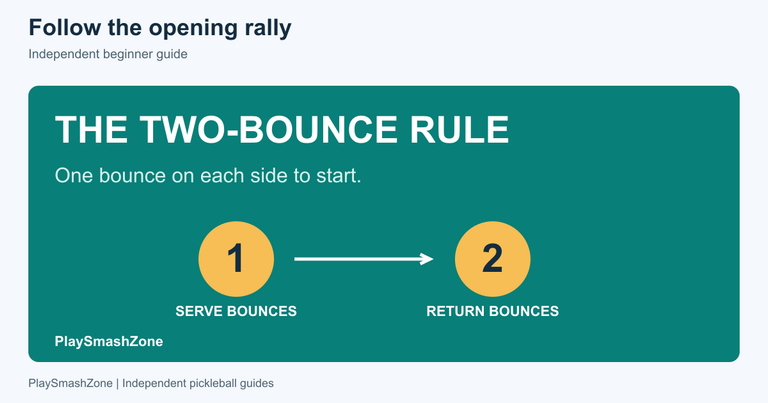
No. That bounce happens before the serve is hit. The receiver must still let the served ball bounce before returning it.
Before serving, check your position, make the correct release for your chosen method, finish the score call and aim beyond the kitchen into the diagonal court. Those checks cover the decisions that most often get overlooked.