The Two-Bounce Rule in Pickleball Explained With Examples
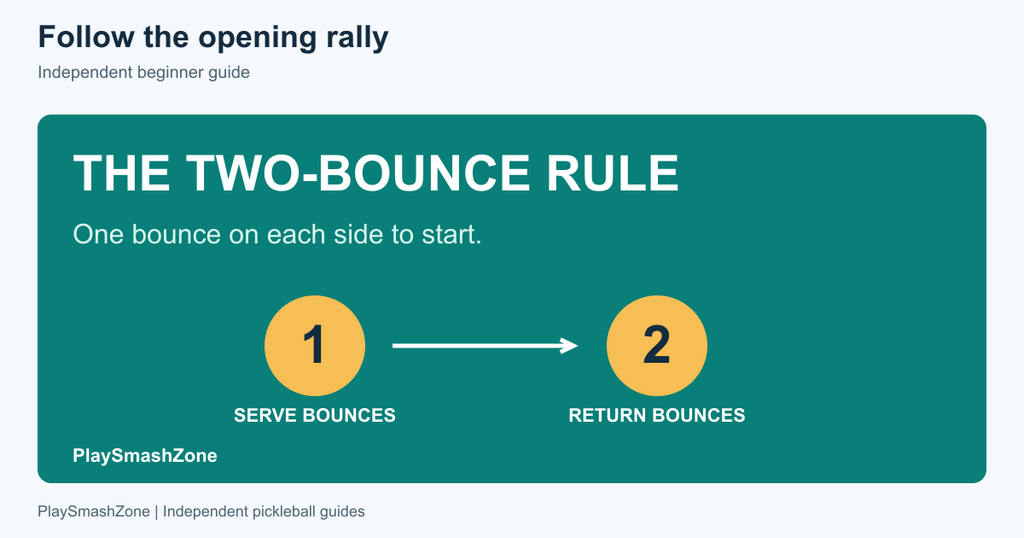
After a serve, the receiving side must let the ball bounce before returning it. The serving side must then let that return bounce before hitting the next shot. Once those two required bounces have happened, players can generally choose a volley or a bounced shot, subject to the other rules.
The two bounces happen on opposite sides of the net: one on the receiving side, then one on the serving side. They do not mean that an ordinary player should let the same incoming ball bounce twice.
This explanation uses the 2026 USA Pickleball Official Rulebook. PlaySmashZone is independent and has no USA Pickleball affiliation or endorsement.
The Two Required Bounces
Rule 10.A applies to the serve and the return of serve. Each must bounce before the opposing side hits it.
A volley is a shot struck before the ball bounces. A groundstroke is played after a bounce. During the first two returns of a rally, groundstrokes are required.
Bounce 1: Let the Serve Land
Alex serves to Nisha. Nisha must let the served ball bounce before returning it.
Even if the serve floats slowly toward her at a comfortable height, she cannot hit it out of the air. Being outside the kitchen does not change that requirement.
Bounce 2: Let the Return Land
Nisha returns the bounced serve to Alex’s side. Alex must now let that return bounce before hitting it.
In doubles, the same obligation applies to Alex’s partner. The partner cannot intercept the return as a volley simply because they were not the person who served.
Follow One Rally, Shot by Shot
Consider this ordinary singles rally:
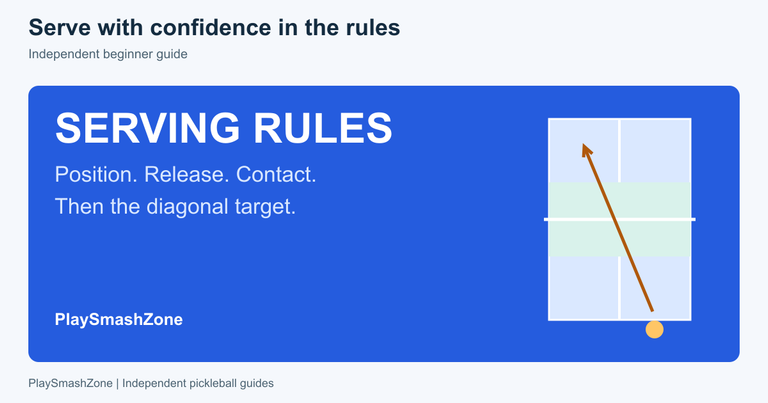
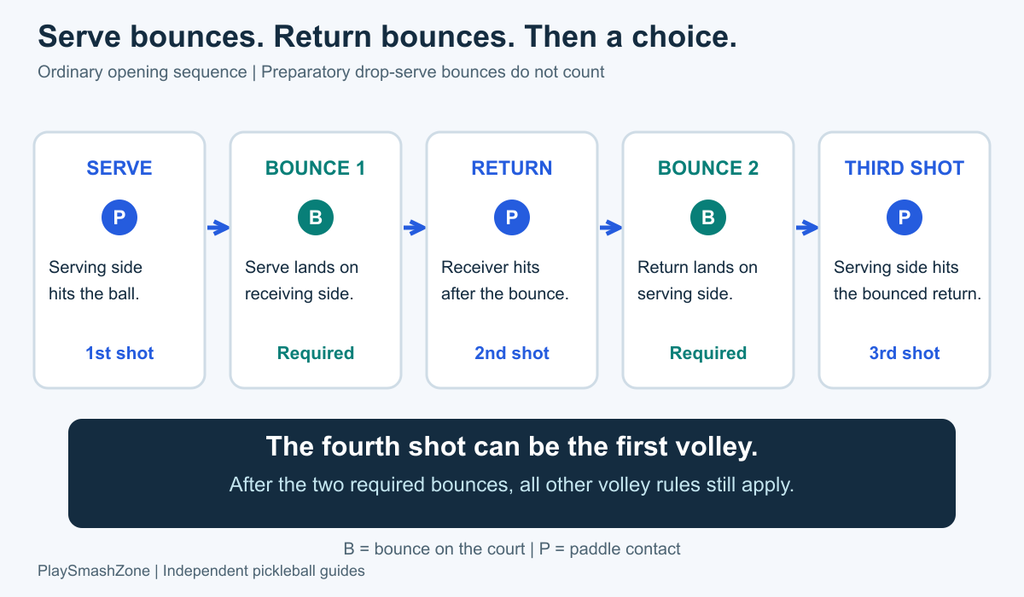
- Serve: Alex sends the ball into Nisha’s correct diagonal service court.
- First required bounce: The serve lands on Nisha’s side. She waits for that bounce.
- Return: Nisha hits the ball back toward Alex.
- Second required bounce: The return lands on Alex’s side. He waits for it.
- Third shot: Alex hits the bounced return back to Nisha.
Now Nisha may volley Alex’s shot if her position and movement satisfy the kitchen rules. Alternatively, she may let it bounce and play a groundstroke.
Counting paddle hits, the serve is shot one, the return is shot two and Alex’s next stroke is shot three. In this ordinary sequence, shot four is the earliest possible volley.
That is different from saying “the third shot can be a volley.” The third shot is the serving side’s return of the ball that had to bounce.
What If Someone Volleys Too Early?
The Receiver Volleys the Serve
Rule 10.A.1 makes this a fault against the receiver. A serve that was going to land in bounds still has to bounce before being returned.
For example, Nisha steps forward and blocks Alex’s serve before it lands. The fault occurs because she skipped the required bounce, even if the block otherwise crosses the net cleanly.
The Serving Side Volleys the Return
Rule 10.A.2 makes this a fault against the serving side, whether the server or the server’s partner hits the early volley.
This is easy to overlook when the return is high and inviting. A player might be standing well behind the kitchen line with a clear shot, yet still have to wait because it is the return of serve.
These are faults, not automatic replays. In play without a referee, players are expected to call their own and their partner’s faults; the general rules limit an opponent’s authority to enforce other types of fault calls. In an officiated match, the referee applies the relevant procedure.
Does the Rule Apply to Singles and Doubles?
Yes. The number of players does not change the opening sequence.
In singles, each player is responsible for the required bounce on their side. In doubles, the correct receiver returns the bounced serve, and either serving-side player may play the next ball after it bounces.
It is a rule about the ball’s opening journey, not a requirement that every player personally touch the ball once before anyone volleys.
For instance, a receiving team’s partner may legally volley the fourth shot without having hit any earlier ball, provided all other requirements are met.
Does the Ball Have to Bounce Exactly Once?
For ordinary standing play, the serve and return must bounce once before being returned, and the player must hit before a second bounce. Rule 10.B makes failure to return the ball before that second bounce a fault.
After the opening sequence, an incoming shot may usually be volleyed or played after one bounce. Letting it bounce twice on your side is still a fault in ordinary play.
There is a separate extra-bounce allowance for wheelchair players and eligible adaptive standing players, explained below. That allowance should not be confused with the two required opening bounces.
A Drop Serve’s Preparatory Bounce Does Not Count
When a server uses a drop serve, the ball bounces before the server strikes it. That is part of preparing the serve.
The two-bounce rule concerns the served ball and its return. The receiver must still let the serve bounce, and the serving side must still let the return bounce. A preparatory bounce on the server’s side does not satisfy either requirement.
Two-Bounce Rule vs Kitchen Rule
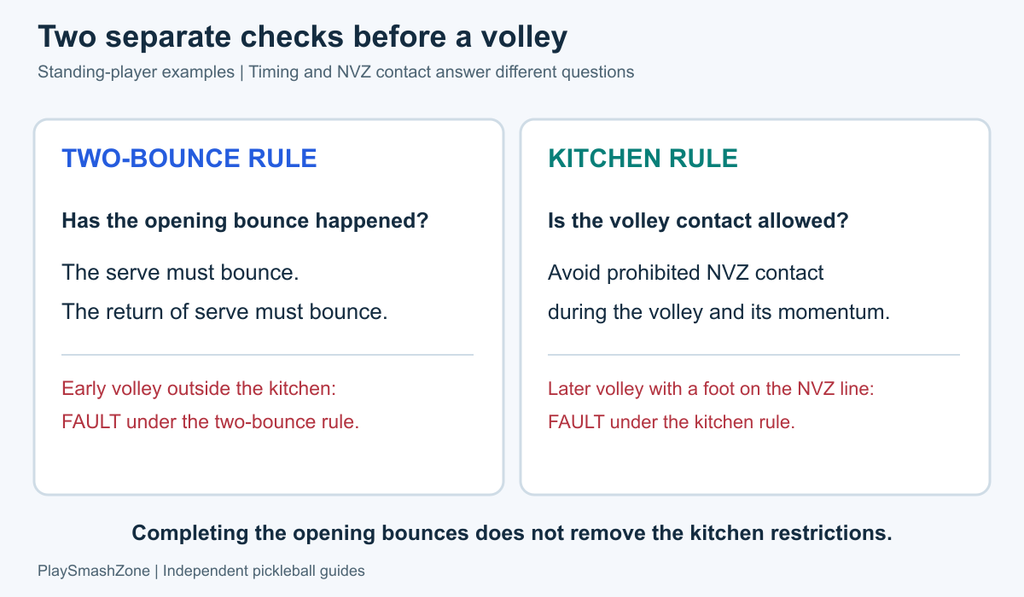
The two rules answer different questions:
| Rule | Question it answers | Example of a violation |
|---|---|---|
| Two-bounce rule | Has the serve or return bounced before being returned? | The serving partner volleys the return from well outside the kitchen. |
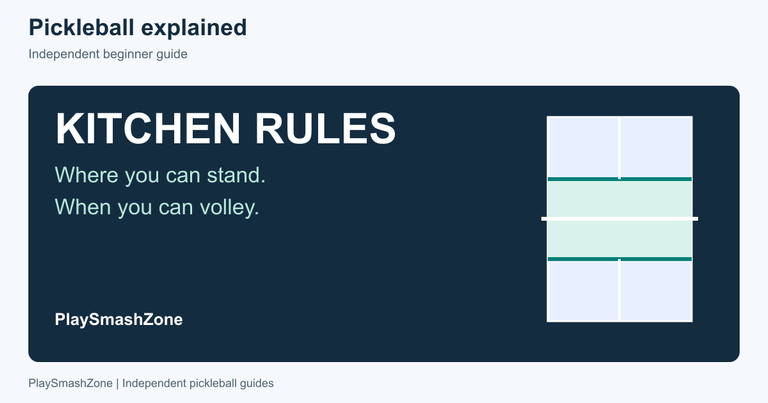
| Kitchen/NVZ rule | Is the player’s contact with the zone permitted during the volley and its momentum? | After the opening bounces, a standing player volleys with a foot on the kitchen line. |
Completing the required bounces does not make the kitchen available for volleying.
Suppose Nisha waits for the serve to bounce, Alex waits for the return to bounce, and Nisha then volleys the fourth shot while touching the NVZ line. She has not violated the two-bounce rule, but she has committed a kitchen fault.
Conversely, an early volley outside the kitchen can satisfy the kitchen-position requirement while breaking the two-bounce rule.
Wheelchair and Adaptive Bounce Allowances
Section 25 modifies the usual maximum-bounce rule for certain players. It does not remove the requirement to let the serve and return bounce.
Wheelchair Players
A wheelchair player may return a ball after a second bounce, but must hit it before a third. The first bounce must be legally in bounds; the second may be anywhere on the playing surface, including outside the court lines (Rule 25.A.9).
For example, a legal return of serve lands inside a wheelchair player’s court, then bounces outside the sideline on the surrounding playing surface. The player may still return it before the third bounce, assuming nothing else has ended the rally.
An out-of-bounds first bounce is not rescued by this allowance.
Eligible Adaptive Standing Players
The 2026 rules also provide a two-bounce allowance for eligible adaptive standing players. It is not automatic for everyone with a disability or everyone taking part in an adaptive event.
Rule 25.B.3 addresses the allowance in adaptive standing and hybrid events. The eligibility provisions concern significant effects on mobility, movement, balance or coordination; they also distinguish eligibility for adaptive standing play from eligibility for this particular allowance.
An eligible player must declare the option before the match and keep that option in effect throughout the match. Having the allowance does not mean every shot must bounce twice: the player may return a ball sooner when otherwise permitted. The rulebook says a player who doubts their eligibility must not use the option.
For a player using it, the second bounce may occur anywhere on the playing surface, and the return must happen before a third bounce. A ball hitting a fence or wall does not remain playable simply because another bounce was allowed.
In hybrid doubles, the allowance belongs to the qualified player. An ordinary standing partner does not acquire it merely by partnering with a wheelchair player.
Legal or Fault? Opening-Rally Examples
Assume ordinary standing play unless the example specifies an applicable accommodation, and assume the remaining rules are followed.
| Situation | Outcome | Explanation |
|---|---|---|
| The receiver volleys an otherwise legal serve. | Fault | The serve did not bounce before the return. |
| The receiver plays after the serve bounces, but the serving partner volleys that return. | Fault | The serving side skipped the second required bounce. |
| Both required bounces occur; the receiver then volleys the fourth shot from a legal outside-NVZ position and remains balanced outside. | Legal | The opening restriction has been satisfied and no NVZ fault is described. |
| Both bounces occur; a standing player volleys the fourth shot with a foot on the kitchen line. | Kitchen fault | The opening sequence was correct; the later NVZ contact was not. |
| An ordinary standing player lets an incoming ball bounce twice before attempting the return. | Fault | The ordinary maximum is one bounce before returning. |
| A wheelchair player returns a legally landed ball after its second bounce, before the third, with no other intervening fault. | Legal under the allowance | Rule 25.A.9 permits that extra bounce. |
Mistakes That Make the Rule Seem Harder Than It Is
Counting two bounces on the receiving side. Track one required bounce on each side of the net instead. The ordinary receiver should not wait for two.
Counting players instead of shots. A doubles partner does not need a personal opening hit before being allowed to volley later.
Using kitchen position as permission for an early volley. Standing outside the NVZ does not waive the required bounce.
Counting the drop serve’s preparatory bounce. Begin the opening sequence when the serve is struck.
Applying the requirement only after a side out. It applies after every serve, even if the same player is serving consecutive rallies. It does not keep restarting midway through a continuing rally.
A Memory Aid for the Next Rally
Serve lands. Return lands. Then choose.
“Choose” means that the opening bounce requirement has been satisfied. A later volley still needs to comply with the kitchen and other playing rules.
As the receiver, watch the serve land before your return. As a member of the serving side, watch the return land before your next stroke. Those are the two decisions to remember.
Frequently Asked Questions
Can I volley a very short serve?
No. The serve must bounce first. If it lands in the kitchen, it is a service fault; hitting it out of the air is not a substitute for allowing that landing.
Can my partner volley the return if I served?
No. The bounce requirement applies to your side, including your partner.
Is the third shot a volley?
In the ordinary opening sequence, it cannot be: the serving side must play that shot after the return bounces. Shot four can be the first volley.
Does the rule restart at 10-10 or match point?
Every serve starts a new opening sequence, whatever the score. A close score does not change the requirement.
Does the extra wheelchair bounce remove the opening rule?
No. It increases the permitted number of bounces before a return for that player. It does not authorize volleying the serve or return of serve.
If both required bounces happened, can I volley from the kitchen?
No. Kitchen restrictions still apply independently.
Try following only the serve and return during a practice rally. Once you can identify where each must land, the point at which volleying becomes available is much easier to recognise.