Indoor vs Outdoor Pickleball Courts: 2026 Guide
Indoor and outdoor pickleball use the same regulation court dimensions and basic layout. What changes is the environment around the game: the surface underfoot, wind, temperature, lighting, sound and the work needed to keep the court playable.
The most useful comparison is between the actual courts available to you. A dedicated indoor hard court may feel closer to an outdoor hard court than to a nearby school gym. Likewise, a covered outdoor court offers a different experience from either an exposed park court or a fully enclosed, air-conditioned facility.
Indoor vs outdoor pickleball courts at a glance
| Factor | Indoor courts | Outdoor courts |
|---|---|---|
| Regulation layout | Same standard dimensions, markings and net requirements | Same standard dimensions, markings and net requirements |
| Surface examples | Wood gym floors, dedicated sport flooring, acrylic-coated hard courts or suitable modular systems | Acrylic-coated concrete or asphalt bases, suitable modular systems and other outdoor sport surfaces |
| Wind and weather | Enclosed buildings largely remove natural wind and direct rain; temperature control varies | Wind, rain, sun and temperature changes can affect play; covers provide varying protection |
| Visibility | Usually artificial lighting; windows, fixtures and ceiling backgrounds can affect ball tracking | Sun angle, shadows and glare by day; court lighting where installed after dark |
| Bounce and traction | Depend on the floor, ball, cleanliness and condition | Depend on the surface, ball, cleanliness, condition and exposure to weather |
| Sound | Hard walls and ceilings can create reverberation | Sound can reach nearby homes or other outdoor users |
| Upkeep | Floor and line care, plus building, lighting and ventilation maintenance | Debris removal, water management and checks for surface, net and post wear |
| Ball choice | Choose for the surface and the venue or event | Choose for the surface, conditions and the venue or event |
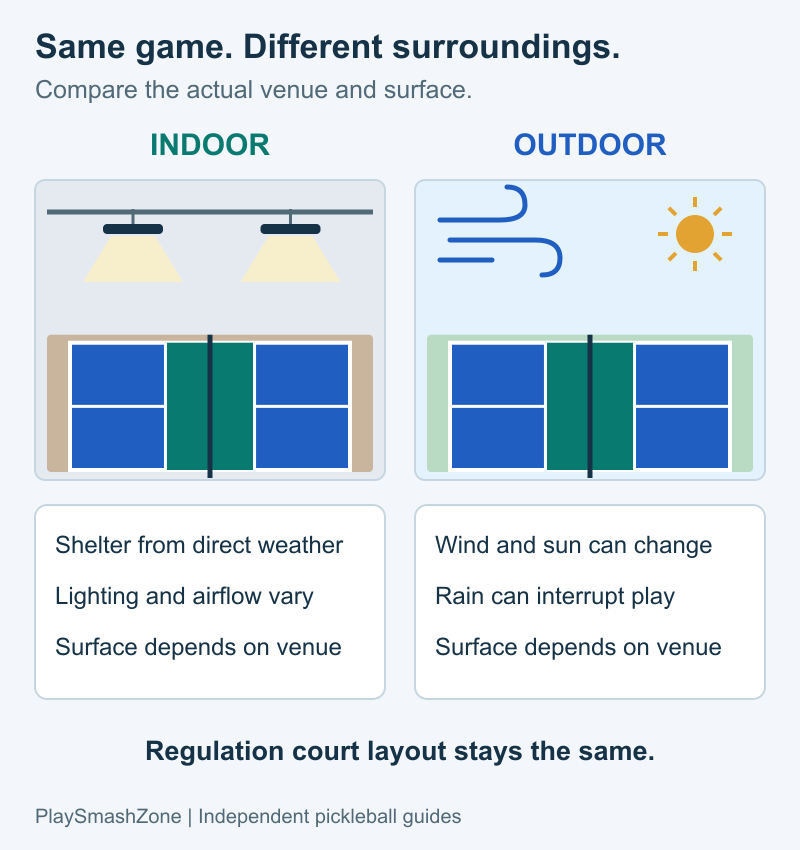
Are indoor and outdoor pickleball courts the same size?
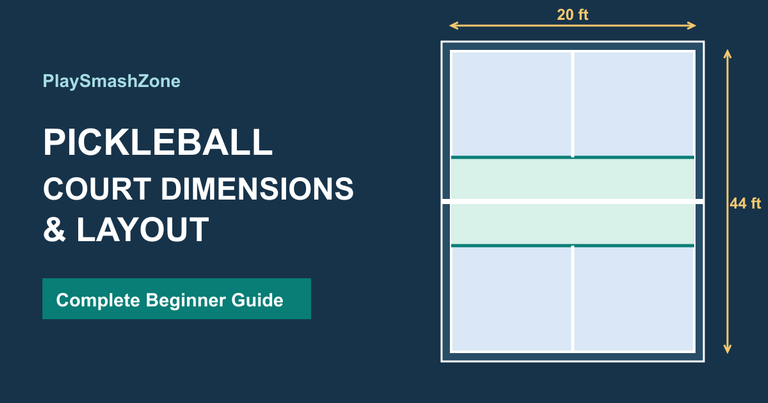
Yes. Under the 2026 USA Pickleball Official Rulebook, the standard court is 20 feet wide by 44 feet long (6.10 × 13.41 m) for singles and doubles. Moving it indoors does not change the kitchen, service-court layout or net requirements.
For the individual measurements and surrounding-space guidance, see Pickleball Court Dimensions and Layout Explained. Here, the focus is how courts with that same layout can feel different to play on.
Surface matters more than the indoor or outdoor label
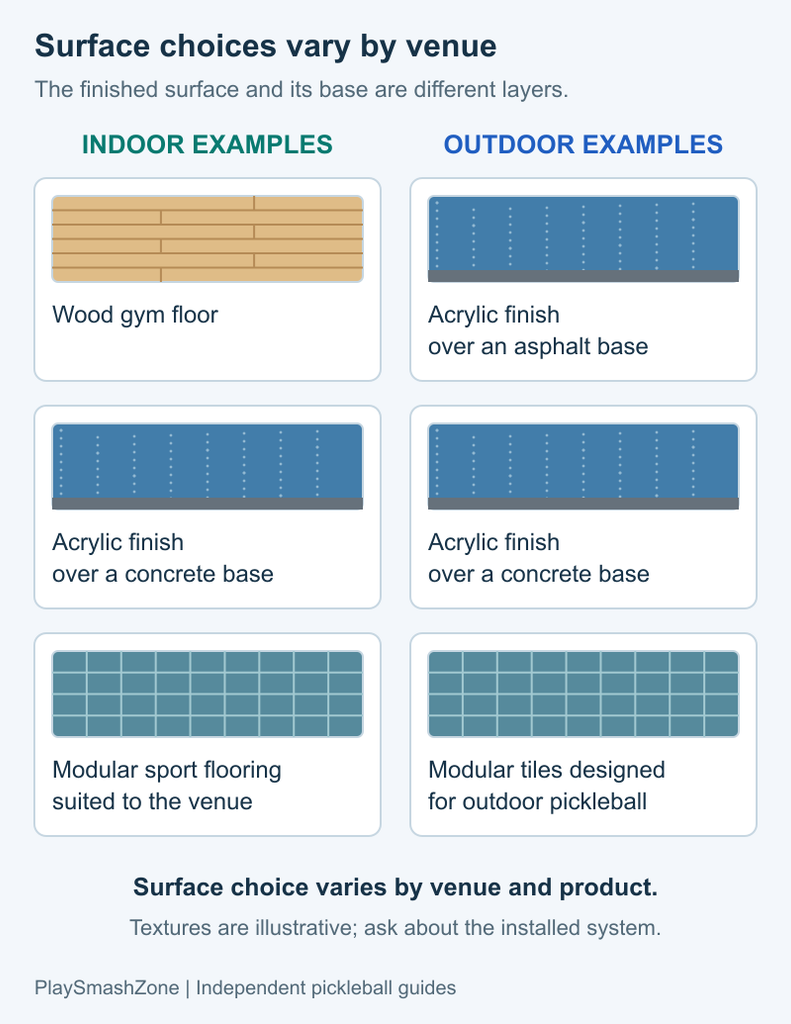
Indoor pickleball is not limited to hardwood. A community gym may have a wood or synthetic sport floor; a dedicated facility may have an acrylic-coated concrete court; another venue may use an appropriate modular flooring system. Outdoors, many hard courts use an acrylic sport coating over concrete or asphalt. Modular systems are another option, provided the product and installation suit outdoor pickleball.
It helps to distinguish the base from the playing surface. Concrete or asphalt can form the structural base, while an acrylic coating provides the finish players move and bounce the ball on. A cushioned surface system can add layers beneath that finish. SportMaster’s pickleball surface guidance describes acrylic systems for both indoor and outdoor installations; Sport Court also offers modular surfaces intended for pickleball.
Texture, firmness and the surface system affect ball response and the feel of movement. Before choosing a venue or ordering a court, ask what the finished surface actually is. “Indoor court” alone tells you little about grip or cushioning. Nor does “concrete court” tell you whether the concrete is coated, bare or covered with another system.
Does the ball bounce differently indoors?
It can, but there is no single indoor bounce or universal indoor speed. A smooth gym floor and a textured hard court may produce different ball responses, particularly when different ball models are used. Surface condition and ball temperature add further variables.
For example, suppose you move from a community gym to an indoor club with acrylic courts. You have stayed indoors, yet the surface and supplied ball may both have changed. Use the warm-up to judge rebound and movement rather than assuming your usual touch will transfer exactly. Manufacturers such as ONIX explain ball selection in relation to court texture, not simply whether a roof is overhead.
Wind, weather and temperature
Wind adds an outdoor variable that an enclosed court largely removes. It can carry a ball sideways or alter how far it travels; serves, lobs and other high shots give it more time to act. A lob that stays comfortably inside the baseline in still conditions may need a larger margin when the wind is carrying it toward the back of the court.
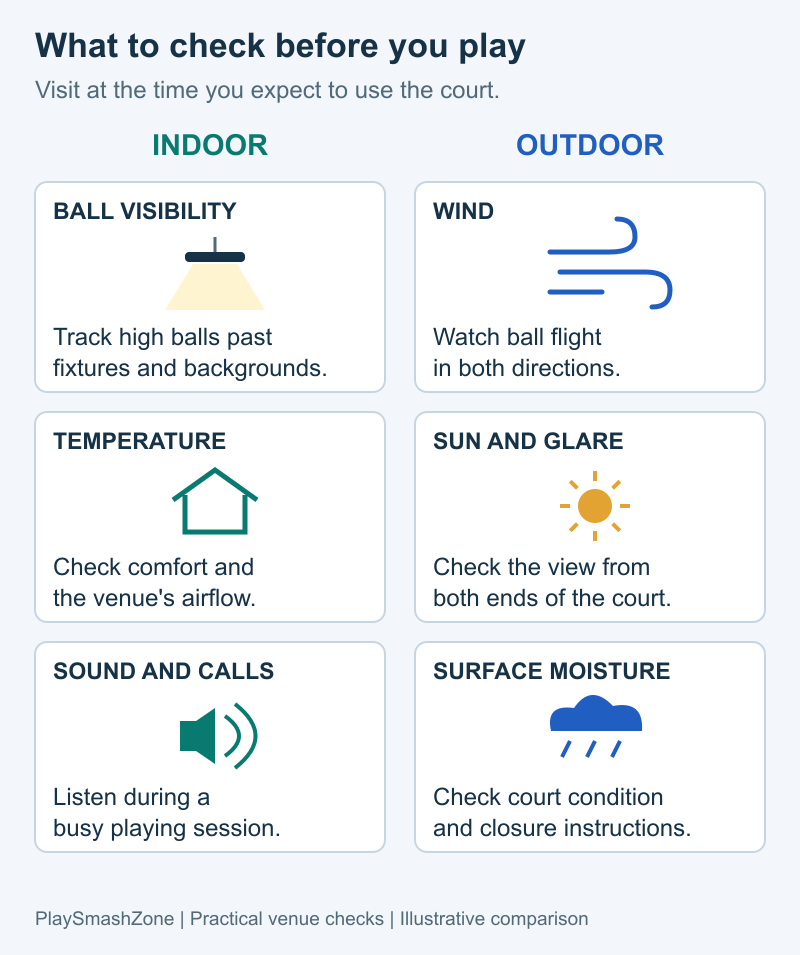
Before an outdoor session, watch a few balls travel in both directions. If the breeze changes, reassess rather than treating every missed shot as a swing problem. Indoor ventilation or open doors can create airflow, but its effect depends on the building and should not be assumed to match outdoor gusts.
Temperature also affects the ball. Selkirk’s explanation of temperature and pickleballs describes plastic becoming more brittle in cold conditions and softer in heat. The amount of change depends on the ball and conditions; it does not justify declaring every cold game faster or every indoor game slower.
Outdoors, rain, dew or other moisture can interrupt play and change footing. Wait for a suitably dry surface and follow the facility’s closure policy. Indoors, shelter reduces direct weather interruption, but an unconditioned hall can still be hot, cold or poorly ventilated. When comparing venues, ask about temperature control rather than assuming that “indoor” means comfortable year-round.
Lighting and visibility
Indoor lighting is usually more predictable than moving sunlight, but brightness alone does not guarantee a clear view. A fixture positioned behind a high ball, glare from windows, or a ceiling close in colour to the ball can make tracking difficult. A gym may also have several sets of court lines competing for attention.
Outdoors, the sun’s angle and shadows change through the day. Evening lighting introduces its own questions about glare and even coverage. USA Pickleball’s lighting guidance emphasises uniform illumination with controlled glare; its court-construction guidance recommends considering outdoor orientation to reduce direct sun in players’ eyes.
For a practical comparison, visit during the hours you expect to play. Follow a few high balls from both ends. A court that looks well lit from the entrance may be harder to read from behind a baseline.
Why indoor pickleball can sound louder
Paddle strikes and voices can reflect from hard walls and ceilings, building up the lingering sound called reverberation. This is a room-acoustics effect, not a different pickleball rule. The mechanism is explained in the OSHA technical manual’s discussion of reflected sound. How noticeable it becomes depends on the room, its acoustic treatment and how many courts are active.
Outdoor courts have fewer enclosing surfaces, but their sound can still reach neighbours, homes and shared public spaces. Neither setting is automatically quiet. For facilities, court location, operating hours and appropriate acoustic design deserve consideration. USA Pickleball maintains resources on sound-mitigation systems; a product listing should not be treated as a guarantee that it will solve a particular site’s noise issue.
If you are choosing a regular venue, visit when it is busy. That gives a better impression of conversation and score-call clarity than an empty-court tour.
Balls, shoes and traction
Choose the ball for the court and session
Balls sold for indoor play often have larger holes and a softer feel, while outdoor models commonly use smaller holes and designs intended for rougher surfaces and wind. These are common design tendencies described in ONIX’s ball guidance. Hole patterns, materials and feel vary by model; one exact hole count does not define every ball in either category.
The rulebook makes a useful distinction: all USA Pickleball-approved balls are acceptable for indoor or outdoor play under Rule 3.C.1. Marketing labels describe intended use; they do not create two separate sets of game rules. A facility or tournament may specify the ball for its sessions. Check that choice before buying equipment or practising for an event.
For recreational play, use a ball suited to the actual surface and agreed upon by the group. An indoor acrylic court may use a ball marketed for outdoor play. Permission to use an approved ball and its suitability for a particular floor are separate questions.
Choose shoes for the surface
Look for court footwear suited to side-to-side movement, with traction appropriate for the surface. ASICS’ court-shoe guidance discusses lateral movement and the different demands of indoor floors and abrasive outdoor courts.
The 2026 tournament apparel rule, 18.B.2, requires soles that do not mark or damage the playing surface. Follow any additional venue policy, keep soles clean and check wear. Wood, textured acrylic and modular flooring can feel different under the same shoes. Two pairs may be useful if you regularly switch surfaces, but they are not a universal requirement.
Maintenance, drainage and durability
Indoor courts still need regular care
Shelter removes some weather exposure, not dust, spills or wear. Shared gyms also need checks for lifting tape, worn markings and scuffs. Cleaning should follow the instructions for the installed floor: the Maple Flooring Manufacturers Association cautions against wet mopping maple sports floors, while acrylic systems have different care procedures.
A facility must also maintain lighting, ventilation and the building itself. An indoor court can remain available during rain and still be unavailable because of a shared-gym timetable or building maintenance.
Outdoors, water and debris need attention
Outdoor upkeep commonly includes removing leaves and dirt, checking cracks or coating wear, inspecting nets and posts, and maintaining drainage. On acrylic courts, SportMaster’s maintenance guidance explains how debris and dirt left in standing water can contribute to staining and surface abrasion.
Rainwater needs a planned route away from the playing surface. Puddles delay reopening, and water management around the court also matters to the underlying construction. Suitable drainage depends on the site and surface system; it cannot be designed from a generic indoor-versus-outdoor comparison.
Indoor courts are not automatically more durable. Service life depends on the installed materials, base, climate, use and maintenance. For an owner, ask what upkeep and repairs the proposed system requires, and what its warranty actually covers, rather than accepting a single lifespan for every court.
Which environment suits your practice?
For a beginner, an enclosed court can make initial practice more predictable by removing wind and direct weather. That advantage is useful only if the floor, lighting, available space and session arrangements also work well. A good outdoor beginner session may be a better choice than a crowded gym with confusing lines.
Outdoors, players gain familiarity with judging sun, wind and changing conditions. Indoors, they can repeat drills without those same interruptions. These are different practice opportunities, not evidence that one setting produces better players.
For competition preparation, use the expected event conditions as a guide. Practising with a comparable surface and the event’s ball reduces the number of unfamiliar factors on arrival. If the tournament is outdoors, include some practice with wind and sun when possible. If it is indoors, find out whether it uses gym flooring or dedicated hard courts rather than relying on the word “indoor.”
What homeowners and facilities should compare
An outdoor project needs a suitable site, court base and surface, water management, and consideration of surrounding properties. Lighting and shade may also be part of the plan. A fully enclosed project adds a building or usable existing structure, overhead space, lighting, ventilation and possibly heating or cooling.
These differences do not support one reliable worldwide price comparison. Converting an available gym is a different project from constructing a new indoor building, just as resurfacing an existing outdoor slab differs from developing a new site. Compare local proposals with the same scope, including the ongoing building or court costs.
Can a basketball gym become a pickleball venue?
Often, a suitable gym can accommodate pickleball with facility-approved temporary court markings and portable nets. Check usable surrounding space, overhead obstructions, floor suitability, visibility, storage and scheduling before treating it as a complete venue. Get the facility’s permission for tape and equipment placement. The court dimensions and layout guide explains the measurement side of that assessment.
What about covered outdoor courts?
Covered courts offer a useful middle option. A structure can provide shade or weather protection, depending on its design, while retaining an open-air setting. USA Pickleball’s shading guidance includes open-air facilities and considerations for adding structures around courts.
A shade canopy is not necessarily rainproof, and a roof with open sides may still admit wind or wind-driven rain. It also does not provide the temperature control of an enclosed building. Ask what protection the proposed structure supplies during the conditions that usually interrupt local play.
Which should you choose?
| Your priority | What to compare |
|---|---|
| Keeping regular sessions through rainy or cold seasons | An enclosed venue’s weather protection, temperature control and actual booking availability |
| Preparing for an outdoor competition | A comparable outdoor surface, the event’s ball and opportunities to practise in changing conditions |
| Learning the basics | Clear lines, suitable traction, instruction and a manageable environment; either setting can work |
| Managing hot or windy conditions | Enclosed facilities or suitable covers, while checking ventilation, open sides and remaining exposure |
| Building or owning a court | Site conditions, building or roof requirements, drainage, noise, maintenance and comparable local quotes |
For example, a player whose evening sessions are repeatedly cancelled by rain may value a dependable indoor booking more than the exact surface match. A player preparing for an outdoor event may keep those indoor sessions for drills and add outdoor practice for environmental familiarity.
Try the actual venue before committing to a membership, and inspect a comparable installed surface before selecting a construction system. Your decision becomes clearer when it is tied to when, where and how you intend to play.
Common myths about indoor and outdoor courts
- “Indoor courts are smaller.” Standard regulation dimensions stay the same.
- “Indoor pickleball always means a wood floor.” Indoor venues also use other sport-floor and hard-court systems.
- “Outdoor pickleball is always faster.” Surface, ball and conditions affect playing feel; location alone does not establish speed.
- “Indoor play needs different game rules.” The core rules do not change because of the roof. Venue and event procedures still need checking.
Frequently asked questions
Can you use an outdoor pickleball indoors?
Yes, where it is suitable for the surface and permitted by the venue or event. Rule 3.C.1 allows approved balls in either environment; dedicated indoor hard courts may use outdoor-labelled models.
Can you use an indoor ball outdoors?
An approved ball is not prohibited simply because it is sold for indoor use. Its behaviour and wear may be less suitable for a rough surface or wind, so follow the venue’s choice or select a model intended for those conditions.
Which surface is best for pickleball?
There is no single answer for every venue. Compare ball response, traction, comfort, installation suitability and maintenance for the particular system and intended use.
Do you need different shoes indoors and outdoors?
Not necessarily. Your shoes need to suit the surface and any venue requirements, such as a non-marking-sole policy. Regular play on different surfaces may justify separate pairs.
Is indoor pickleball always easier?
Indoor shelter removes some environmental variables, but the floor, lighting, acoustics and session conditions still matter. Either environment can support beginner learning.
Does a roof solve outdoor weather problems?
Only to the extent its design provides protection. Shade structures, rainproof roofs and fully enclosed buildings offer different levels of shelter, airflow and temperature control.
Indoor and outdoor courts share the game’s basic layout. Choose between them by looking at the surface, conditions, access and upkeep of the specific venue—and how closely those fit the way you want to play.