How to Play Pickleball: Complete Beginner Guide (2026)
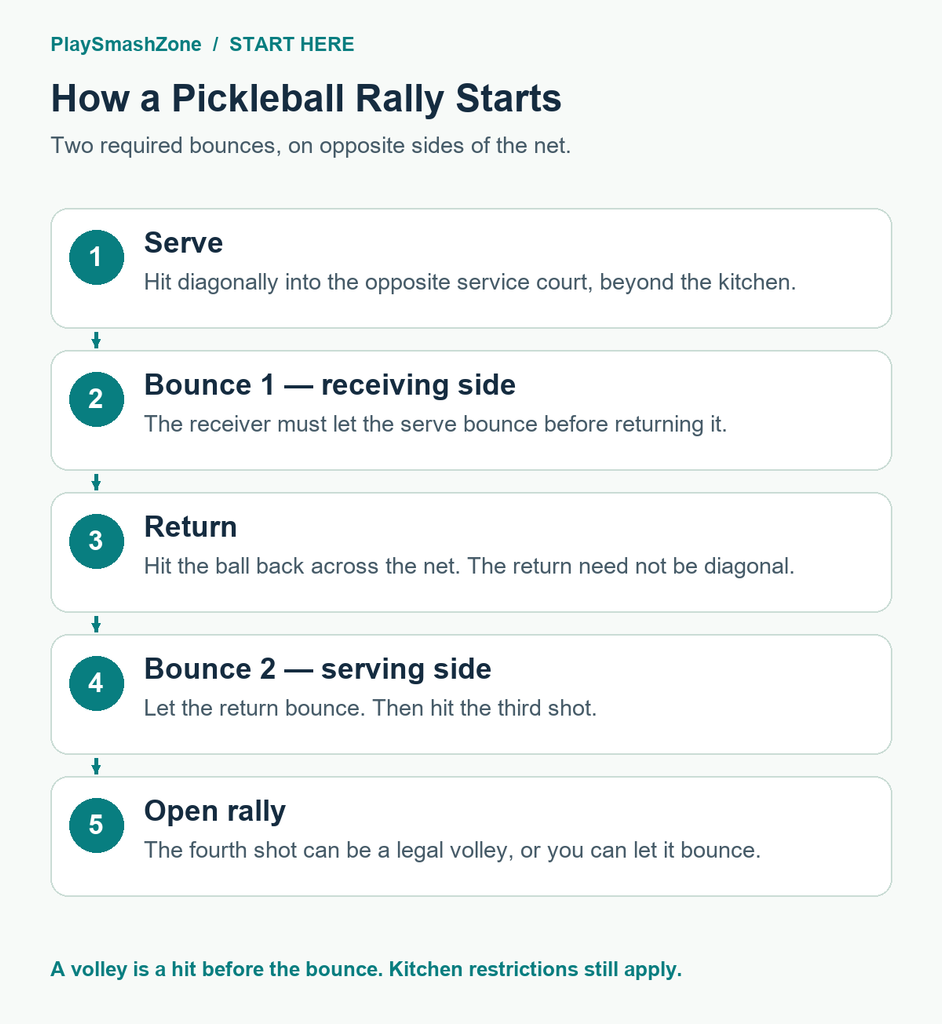
Pickleball is a paddle game for two or four players, played with a perforated ball over a net. Start each rally with a diagonal serve. The receiver lets it bounce and returns it; the serving side must also let that return bounce. After those two required bounces, players can hit after a bounce or volley when the kitchen rules allow. A fault ends the rally, then the score or serving turn changes according to the scoring system.
This guide follows standard scoring, where only the serving side earns points. It explains the separate 2026 provisional rally-scoring option below. Rules have been checked against the 2026 USA Pickleball Official Rulebook, available through the official rules page.
The examples describe ordinary standing play. The rulebook has separate adaptive and wheelchair provisions, including different bounce allowances.
Pickleball in 60 Seconds
- Serve diagonally into the opposite service court, beyond the kitchen.
- The receiver lets the serve bounce.
- The receiver returns the ball over the net.
- The serving side lets the return bounce.
- Play opens up: hit the next shot after that bounce; from then on, legal volleys are also possible.
- Continue until a fault, such as a ball landing out or bouncing twice before it is returned.
- Update the score and server. With standard scoring, winning while serving earns a point; winning while receiving changes the service turn instead.
What Do You Need to Play Pickleball?
Bring a paddle for each player, a pickleball, a net and a marked court. Wear footwear suited to stopping and moving sideways; check the venue’s surface requirements. You need two players for singles or four for doubles.
You do not need to buy a full kit before trying the game. Check whether the venue lends paddles and balls and provides a net.
Understanding the Pickleball Court
The court is 20 feet wide and 44 feet long (6.10 × 13.41 metres), for both singles and doubles.
- Baselines are the back boundaries; sidelines are the long side boundaries.
- The kitchen, officially the non-volley zone or NVZ, extends 7 feet from the net on each side.
- A centerline divides the area behind each kitchen into two service courts. It stops at the kitchen line.
- A serve must land in the diagonally opposite service court, beyond the kitchen.
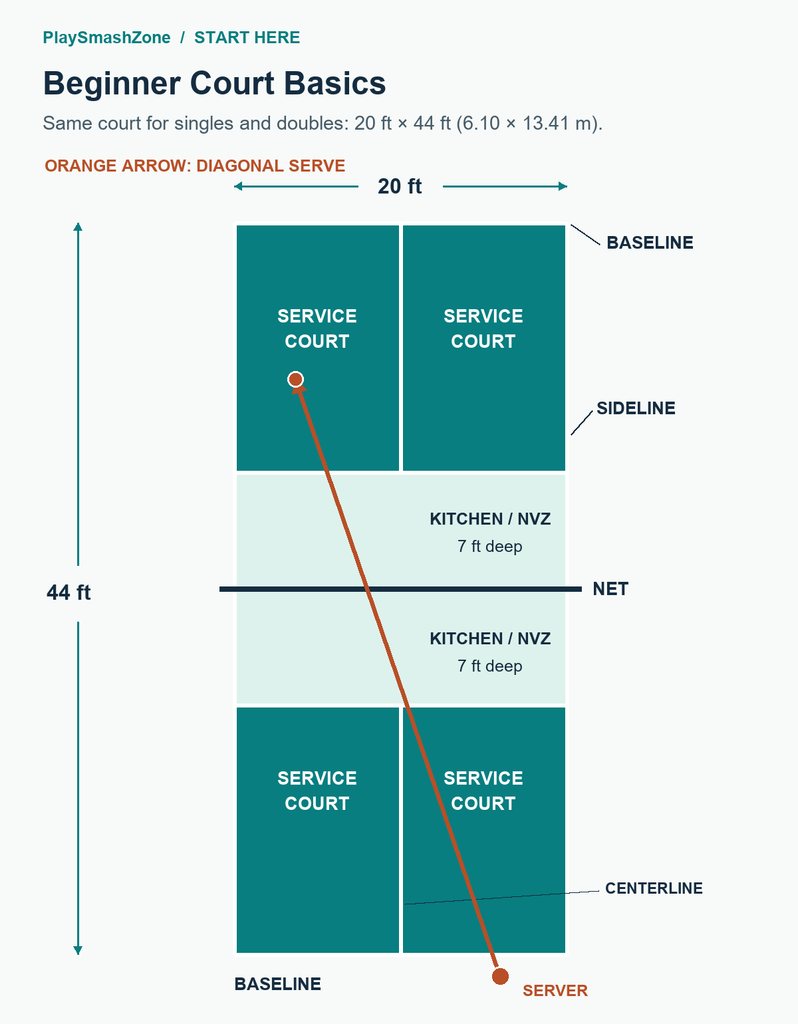
The arrow shows one legal serve direction. The other starting side reverses the diagonal.
For measurements beyond this playing overview, see the pickleball court dimensions and layout guide.
Singles vs Doubles
In singles, one player covers each end. When serving, use the right service side if your own score is zero or even, and the left if it is odd. Right and left always mean as you face the net from your end.
In doubles, two players share each end. Standard scoring tracks which partner is serving as well as the team scores. Usually both partners get a service turn before the opponents serve, with one exception at the start of the game.
How Does a Game Start?
Agree on the scoring system and winning target first. For a casual game, use a fair method to decide who gets the first choice of serve, receive or court end. In tournament play, the rulebook’s selection procedure determines the first choice; winning a coin toss does not automatically mean serving.
The first server begins on the right, serving diagonally. In singles, the opening call is “0–0.”
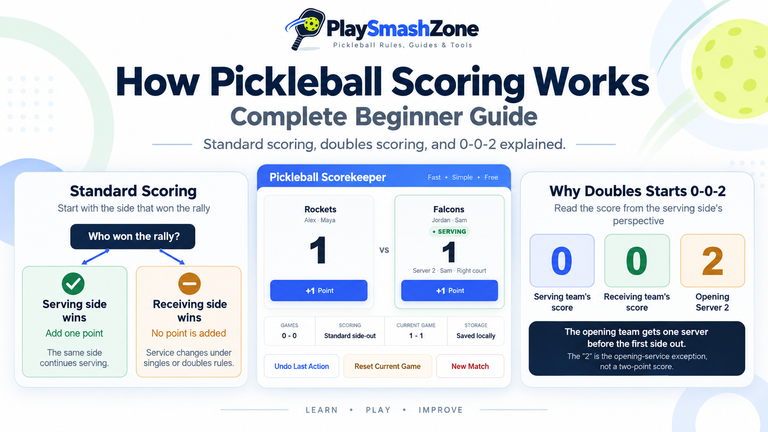
In standard doubles, it is “0–0–2.” The opening team gets only one service turn, so its starting server is designated server 2. When that team loses a rally, service passes to the opponents. The second team then gets the normal two-server sequence.
Choose and remember each team’s starting server. That player’s correct service position is on the right when their team’s score is even, and on the left when it is odd; their partner is opposite. Server numbers 1 and 2 describe turns in the current service rotation, not permanent player identities.
How to Serve
Stand behind the baseline in the correct serving area. When you strike the serve, at least one foot must touch the ground in that area. Neither foot may touch the court or baseline, or the ground beyond the imaginary extensions of the sideline and centerline.
In self-officiated play, call the complete score before serving. Once the score call is completed, the serve must be hit within 10 seconds. Aim diagonally beyond the kitchen.
There are two legal approaches:
- Volley serve: release and hit the ball before it bounces. At contact, the paddle must move in a clear upward arc, the ball must be no higher than your waist, and the highest part of the paddle head must be no higher than the highest part of your wrist joint.
- Drop serve: release the ball from a natural, unaided height without propelling it, let it bounce, then hit it. The volley serve’s contact-height and paddle-motion restrictions do not apply, but the other serving requirements still do.
Do not deliberately add spin when releasing the ball. A serve landing on the correct service court’s baseline, sideline or centerline is in. A serve touching the kitchen line is a fault. A serve that touches the net and still lands legally remains in play.
For demonstrations and the detailed restrictions, use the complete serving rules guide.
The Two-Bounce Rule
The serve must bounce on the receiving side before the return. That return must bounce on the serving side before the next shot. These are one bounce on each side, not two bounces before each hit.
Imagine a serve landing near the receiver’s baseline. The receiver returns it after the bounce. Even if the return arrives at an easy height, neither the server nor the server’s partner may volley it: they must wait for its bounce.
A drop serve’s bounce before the server strikes the ball does not count toward this sequence. The two-bounce rule guide explains that distinction and other opening-rally situations.
What Happens During a Rally?
A rally is the exchange that begins with a serve and continues until play ends. A volley means hitting the ball before it bounces.
After the required opening bounces, you may return the ball after a bounce or volley it legally. Send it across the net to land inside the opponents’ court or on a boundary line. In ordinary standing play, return it before a second bounce.
You do not earn a point simply for making a good shot. First the rally must end; then the scoring system determines whether anyone scores.
What Is the Kitchen?
The kitchen is the non-volley zone, including its boundary lines, extending 7 feet from each side of the net. You may enter it and hit a ball that has bounced. Standing there is not automatically a fault.
The restriction concerns volleys. Do not volley while touching the kitchen or its line, and do not let your volley’s momentum carry you into it—even after the ball becomes dead. Something you are wearing or carrying can also cause an NVZ contact fault.
After being in the kitchen, establish both feet on the ground outside it before volleying. For the contact and momentum details, see the kitchen and non-volley-zone rules.
How Pickleball Scoring Works
Under standard scoring, only the serving side earns a point. If you win a rally while serving, add one point and serve again from the other side. Winning while receiving earns no point.
In singles, a receiving player’s rally win transfers the serve to them. In doubles, it ends the current server’s turn: the partner serves next, or service passes to the opponents if the second server’s turn has ended. That transfer to the other side is a side out.
| Format | Score-call order | Example |
|---|---|---|
| Standard singles | Server’s score, receiver’s score | “4–2”: server has 4, receiver has 2. |
| Standard doubles | Serving team’s score, receiving team’s score, server number | “4–2–1”: serving team has 4; its first server is serving. |
Remember that the opening doubles call, 0–0–2, uses the one-server exception described above. It does not mean anyone has two points.
Standard vs 2026 provisional rally scoring
| Question | Standard scoring | 2026 provisional rally scoring |
|---|---|---|
| Who earns a point? | The serving side, if it wins the rally. | The rally winner, including on game point. |
| How many numbers are called in doubles? | Three. | Two: serving team’s score, then receiving team’s score. |
| What happens when a doubles server loses? | Partner serves, or side out after server 2; opening exception applies. | Side out: only one player serves in that service rotation. |
Provisional rally scoring is an official option, not a replacement for standard scoring. Its tournament use has restrictions, including exclusion from double-elimination doubles, 2026 Golden Ticket tournaments and the 2026 National Championships. Follow the format announced for your event.
The detailed pickleball scoring guide covers both systems beyond this starter explanation.
How Do You Win a Game?
A common recreational agreement is first to 11, win by two. At 10–10, reaching 11 is not enough; 12–10 wins, while 11–11 means keep playing.
The target depends on the format. Standard-scoring tournaments include matches played best two of three games to 11, best three of five to 11, and single games to 15 or 21. A single game to 11 is also permitted in a single game to 11 is also permitted in round-robin events with six or more teams. round-robin formats with six or more teams. Provisional rally-scoring tournament formats can use 11, 15 or 21.
Tournament games normally require a two-point margin, with an exception allowing team-play events to use win by one. For your first casual game, agree on one clear target and margin before serving.
What Is a Fault?
A fault is a rule violation that ends the rally. Familiar examples include:
- An illegal serve, or a serve landing in the kitchen.
- A ball landing outside the court without touching a valid boundary line.
- A return failing to cross the net and landing back on the hitter’s side.
- Volleying the serve or the return of serve before its required bounce.
- A kitchen contact or momentum violation connected to a volley.
- Letting the ball bounce twice before returning it in ordinary standing play.
A net touch alone is not necessarily a fault: a ball can clip the net, cross and land legally. The consequence of a fault is also not automatically “the opponents get a point”—use the scoring system and current server.
Follow One Rally Step by Step
Here is a hypothetical standard-scoring singles rally. Maya leads Leo 3–2.
- Maya calls “3–2” and serves from the left. Her own score is odd. The serve clears the kitchen and lands in Leo’s diagonally opposite service court.
- Leo lets the serve bounce. This satisfies the receiving side’s required bounce.
- Leo returns it deep into Maya’s court. A return can land anywhere in the opponents’ court; it need not go diagonally.
- Maya lets the return bounce. This satisfies the serving side’s required bounce.
- Maya hits the third shot after that bounce. Both opening bounce requirements have now been met.
- Leo volleys the fourth shot from outside the kitchen. He stays clear of the NVZ and its lines through the volley and its momentum.
- Maya lets that shot bounce once and returns it. Allowing a bounce remains an option after volleying becomes legal.
- Leo’s next shot lands beyond Maya’s sideline without touching it. Leo faults. Maya wins the rally while serving, so she earns a point.
The next call is “4–2.” Maya continues serving, now from the right because her score is even.
A Standard Doubles Game in Six Rallies
Nora and Eli face Priya and Sam. Nora and Priya are their teams’ designated starting servers. Every serve lands legally, and nobody volleys a ball before a required bounce. Each row identifies the fault ending that rally. Right and left are from each player’s own end, facing the net.
| Serve before the rally | Rally-ending fault | What happens next? |
|---|---|---|
| Nora, right: 0–0–2 | Priya’s return lands long. | Nora’s team scores. Nora serves from the left at 1–0–2. |
| Nora, left: 1–0–2 | Sam’s later return fails to cross the net. | Another serving point. Nora serves from the right at 2–0–2. |
| Nora, right: 2–0–2 | Nora’s third shot fails to cross the net. | Side out: the opening team had only one server. Priya serves from the right at 0–2–1. |
| Priya, right: 0–2–1 | Priya lets the return bounce, then hits her third shot out. | No receiving point. Partner Sam serves from the left at 0–2–2. |
| Sam, left: 0–2–2 | Eli’s return lands long. | Sam’s team scores. Sam serves from the right at 1–2–2. |
| Sam, right: 1–2–2 | Sam’s third shot fails to cross the net. | Side out. Nora serves from the right at 2–1–1. |
Notice the fourth row: Sam serves from the left even though his team has zero points. In doubles, do not apply the singles shortcut to every server. Track the partners’ positions and service turns. Partners switch service sides after their team scores while serving, not merely because they win a rally while receiving.
Where Should Beginners Stand?
Official rules: the server must use the correct serving area, and the correct receiver takes the diagonal serve. Other positioning is generally unrestricted, subject to rules such as the required bounces and NVZ restrictions. There is no universal rule requiring both partners to stand at the baseline.
Beginner positioning advice: start with room to handle a deep ball. On the serving team, staying back initially helps both partners remember to let the return bounce. Once the required bounces are complete, move with your partner and avoid leaving a large gap between you. Near the kitchen, leave enough balance and space to stop outside it when volleying.
These are practical starting points, not mandatory positions or a promise of winning tactics.
Common Beginner Mistakes
| Mistake | What to remember |
|---|---|
| Volleying the serve or its return | Each must bounce on its respective side first. |
| Treating the kitchen as forbidden ground | You may enter; the key restrictions concern volleys. |
| Touching the kitchen line during a volley | The line belongs to the NVZ. |
| Forgetting the service side | Check the score and correct positions before serving. Position errors have specific correction rules; do not assume every mix-up automatically loses the rally. |
| Reading 0–0–2 as two points | The last number is the opening server designation. |
| Awarding a receiving point under standard scoring | A receiving win changes service instead. |
| Calling every line ball out | Boundary lines are in; the kitchen line is the important exception on a serve. |
Rushing toward the net before the return bounces is a positioning mistake that can lead to an early-volley fault. Hitting a gentle but legal shot is not a rule mistake.
Your First Pickleball Game Checklist
Before the first serve:
- Identify the baselines, sidelines, kitchen lines and service courts.
- Agree on standard or provisional rally scoring, the target and winning margin.
- Choose the first serving side and, in doubles, identify each team’s starting server.
- Confirm the diagonal receiver and opening score call.
- Remember one required bounce on each side and the kitchen’s volley restrictions.
Between rallies:
- Confirm the score, next server and correct service side before the next serve.
- Call the full score clearly.
- Watch where the ball lands; if you cannot clearly call it out, treat it as in.
- In doubles, communicate about balls between you and track your service turn together.
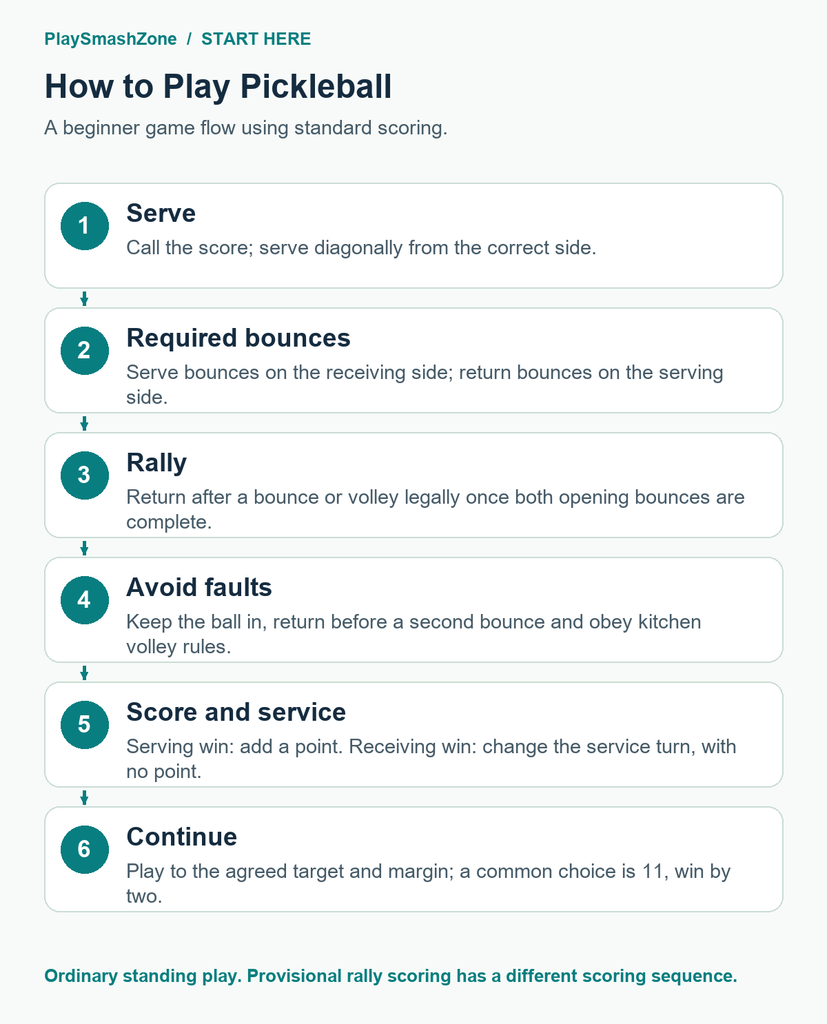
Use this sequence between points until the game’s rhythm becomes familiar.
Does Pickleball Work the Same Indoors and Outdoors?
The basic court dimensions and core rules remain the same. Wind, surface, lighting and ball choice can change how play feels. Check the venue’s conditions rather than learning a separate indoor rule system. The indoor vs outdoor pickleball court comparison covers those practical differences.
What If You Are Unsure About a Rule?
For a situation you want to understand, the PlaySmashZone Rule & Fault Checker is an educational way to work through the relevant details. It is not a referee replacement or binding tournament authority. For an event ruling, follow the event’s officials and applicable rules.
Keeping Score More Easily
If remembering the service sequence distracts you, the PlaySmashZone Pickleball Scorekeeper can track it as you enter rally winners. Select the agreed scoring format and check your entries together; the tool does not observe the court or decide faults for you.
Beginner Questions
Can two people play on the same court used for doubles?
Yes. Singles uses the same 20-by-44-foot court, with one player covering each end.
Do I have to hit every ball after a bounce?
No. The serve and return must bounce first. Afterward, you can volley when legal, including staying clear of the kitchen during the volley and its momentum.
Does a ball bouncing in the kitchen become unplayable?
No. You may enter and return it after the bounce. In ordinary standing play, reach it before it bounces a second time.
What is the easiest format to remember for a first game?
Agree on standard scoring to 11, win by two, and say the score before every serve. In doubles, remember the opening 0–0–2 exception; after the first side out, track both service turns.
Remember the Sequence
Serve diagonally → let the serve bounce → return → let the return bounce → play the rally → respect the kitchen → update the score and server.